Priority Management in Public Administration
01 January 2026
CMP
Shri. Raju Nandkar
Public administration is not merely the implementation of rules; it is the art of taking the right decision at the right time. In a situation marked by limited resources, a large volume of work, and high expectations, priority management becomes the backbone of administration. The ability to identify which task should be done first, which issue requires immediate attention, which problem can be deferred, and which decision demands instant action is known as priority management. The present article discusses this concept in detail.
In today’s fast-paced, social-media-driven world, time management and priority management have gained exceptional importance. Limited available time and an overwhelming number of tasks create constant stress in administrative work. As a result, public servants must manage both time and priorities effectively. However, when faced with numerous tasks, many find it difficult to decide which task should be done now, today, tomorrow, or later. Consequently, highly important tasks are postponed while less important ones get completed. When critical tasks are neglected, administrative functioning is disrupted, leading to frustration and demotivation. Therefore, considering the mountain of tasks ahead, effective priority management becomes essential.
While managing priorities, two key aspects must be considered: importance and urgency. These are often referred to as important tasks and urgent tasks. Based on this, tasks must be sequenced and completed accordingly. This article attempts to explain what priority management is, why it is important, how it can be achieved, the methods involved, and the benefits it offers.
Human beings are thinking creatures, and actions arise from thought. These actions constitute tasks. When tasks are completed within stipulated time frames, dynamic and effective administration emerges. However, the increasing volume of work in administration has become a major challenge. As a result, many public servants find themselves confused about which task to do first and which later. Most importantly, incomplete knowledge and lack of experience often make it difficult to determine priorities accurately every time.
The present era is one of rapid change. Transformations occur at a very fast pace. A task that is of low importance at one moment can become extremely important the next. Priority management helps in determining priorities irrespective of time and place. Those who master priority management experience increased work speed, and administration begins its journey towards good governance.
Priority management is a discipline of management that helps bring clarity and certainty to work processes. For this, it is essential not to keep tasks only in one’s mind but to write them down in a diary or notebook. Often, when tasks are stored only mentally, priorities are set randomly based on what comes to mind first. This results in important or urgent tasks being neglected. Such an approach is certainly not conducive to progress and development. Hence, tasks should be written down in a notebook, diary, or mobile notes. Writing alone is not enough; tasks must also be properly classified and segregated. For this purpose, tasks should be divided into four categories: A, B, C, and D.
A: Extremely important and urgent tasks.
Example: Paying a home loan installment or visiting a doctor due to frequent dizziness. These tasks are both important and urgent and must be done immediately.
B: Important but not urgent tasks.
Example: Repairing a malfunctioning printer at home or painting the house. These tasks are important but do not require immediate action.
C: Not important but urgent tasks.
Example: Buying groceries or repairing a broken mixer. These tasks are not very important but must be done due to necessity.
D: Neither important nor urgent tasks.
Example: Buying new clothes or changing curtains at home.
Although the boundaries between these categories may sometimes be blurred, the more accurately tasks are classified, the faster they can be completed.
Such classification establishes priorities in four stages, ensuring that tasks are completed in the correct sequence. This reduces work-related stress and pressure, brings better planning, accelerates task completion, and creates positivity, enabling subsequent tasks to be completed more efficiently.
Maintaining a mini diary or mobile notes is essential. New tasks or ideas can arise anywhere, and they should be noted immediately; otherwise, they are easily forgotten. Keep a small diary in your pocket or save notes on your mobile phone. Later, transfer these tasks with proper classification into your main diary. Unnecessary items around us often slow down work or create obstacles. Therefore, files, drawers, desks, homes, offices, and rooms should be reviewed at least once a week, and unnecessary items should be removed. This practice is also a key element of time management and priority setting.
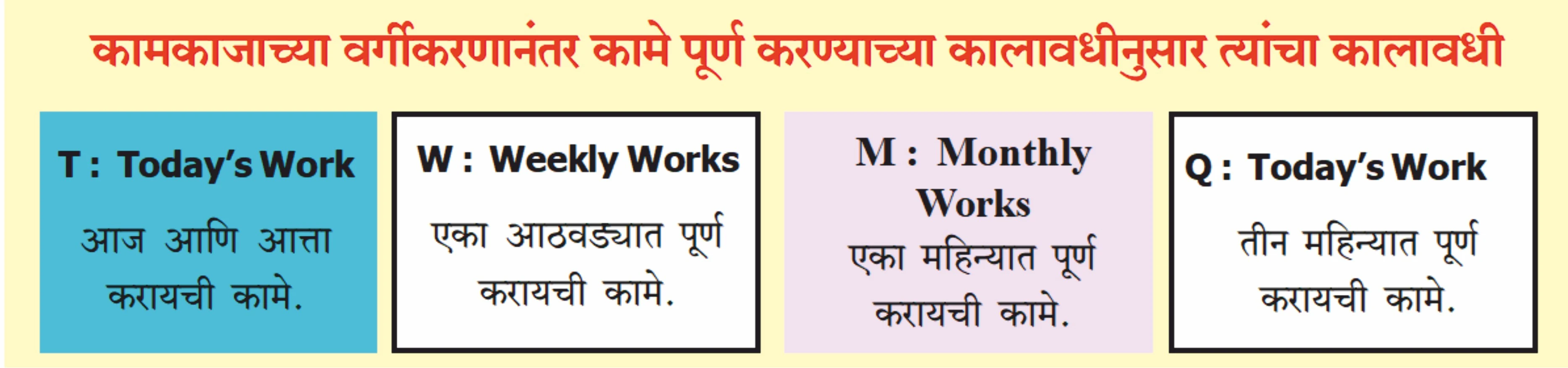
Tasks should be classified using the ABCD and TWMQ frameworks. Time-consuming tasks can be broken down into smaller parts, or completed using “baby steps.” Before starting any task, estimate how much time it will take. This is crucial for determining priority. If the time required is unknown and the task is started, it may have to be left unfinished. Such tasks should be pushed into the M or Q category in terms of priority. Without complete information, not only is time wasted, but frustration and irritation also arise, negatively affecting the overall environment.
One major flaw in priority management is procrastination. Sometimes this happens unintentionally, and at other times deliberately. However, it must be remembered that tasks aligned with our priorities will ultimately have to be done by us. Hence, while planning, a margin of about five percent variation can be allowed.
After completing tasks based on priority management, it is necessary to conduct a time evaluation of the work done. Often, once tasks are completed, no evaluation is carried out. As a result, clarity regarding what is important and what is urgent does not develop. Continuous evaluation helps improve work methods, significantly enhancing effectiveness and efficiency.
Our body and mind function within an energy cycle. Energy levels fluctuate throughout the day. Accordingly, tasks should be prioritized and completed based on one’s energy and capacity. Rest and sleep are extremely important. Exercise, pranayama, yoga, and meditation help maintain physical balance. Making conscious time for recreation, hobbies, and family, friends, and loved ones is equally important and necessary. Therefore, while determining priorities, aspects such as rest, sleep, exercise, pranayama, yoga, meditation, recreation, hobbies, family, friends, and relatives must be taken into account.
Based on self-awareness of one’s abilities and energy, a personal priority management plan should be developed. Such a plan enhances efficiency and work effectiveness. Classifying tasks into ABCD and TWMQ helps strengthen understanding of the importance of tasks and the appropriate time to do them. By completing tasks according to this classification, individuals become stress-free, positive, and enthusiastic, paving the way for the establishment of good governance in administration.
— Rajiv Nandkar
Additional District Collector and Associate Professor
YASHADA
Contact: 9970246417
(Article published in the July–September 2025 issue of YASHADA Yashmanthan. For subscription, contact: 7798703952)



Comments
No comments available